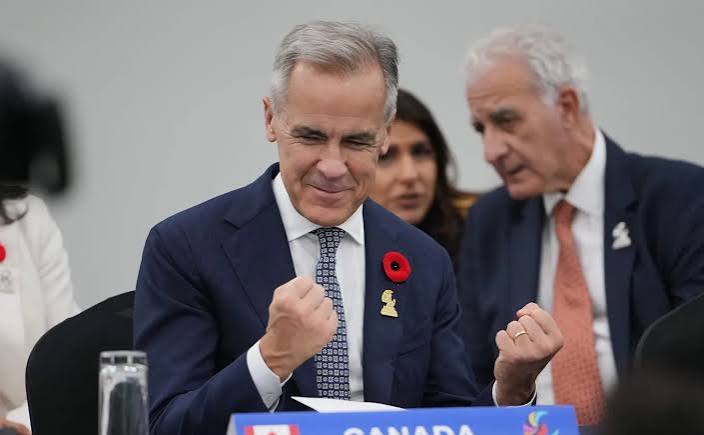
Mark Carney Makes a Major Announcement: Canada’s Economic Future Faces a Turning Point
Canada Prime Minister Mark Carney Breaks From Trump and the U.S. – WSJ
Canadian Prime Minister Mark Carney has unveiled a major economic strategy aimed at strengthening Canada’s independence, attracting investment, and protecting the country from growing global uncertainty. His latest decisions have sparked an important national debate: can Canada build a stronger economy while dealing with rising living costs, trade tensions, and increasing government spending?
A Prime Minister With an Unusual Background
Mark Carney is not a typical Canadian political leader.
Before entering politics, he built an international reputation as an economist and central banker.
Born in Fort Smith, Northwest Territories, and raised in Edmonton, Alberta, Carney studied economics at Harvard University and later completed graduate studies at Oxford University.
His professional career included senior positions at Goldman Sachs, followed by leadership roles at two of the world’s most important central banks.
From 2008 to 2013, he served as Governor of the Bank of Canada, helping oversee monetary policy during the global financial crisis.
In 2013, he became Governor of the Bank of England, making history as the first non-British person to lead the institution.
His experience in international finance became a central part of his political identity. Prime Minister of Canada+1
From Banking to the Prime Minister’s Office
Carney’s political career developed rapidly.
In March 2025, he became leader of the Liberal Party of Canada and was sworn in as the country’s 24th prime minister on March 14.
The transition followed the departure of Justin Trudeau, who had led Canada for nearly a decade.
On April 28, 2025, Carney led the Liberal Party to victory in the federal election and won a parliamentary seat representing Nepean, Ontario. House of Commons of Canada+1
His arrival in office coincided with a period of significant economic uncertainty.
Trade tensions with the United States, concerns about housing affordability, and pressure on household budgets presented immediate challenges.
For Carney, the central question was how to translate his financial experience into effective government policy.
The November 2026 Budget That Has Attracted National Attention
On November 5, 2026, Carney’s government unveiled a federal budget titled Masters of Our Destiny.
The budget outlines a wide-ranging economic strategy intended to encourage business investment, strengthen infrastructure, and reduce Canada’s dependence on the United States.
Among its main proposals are approximately C$142.1 billion in multiyear spending and tax measures.
The government also projects a federal deficit of C$62.3 billion for the 2026–27 fiscal year.
Its economic forecasts suggest that growth could slow to around 1% in 2026 before increasing to approximately 1.7% in 2027. AP News+1
Canada’s 2026 federal budget — key figures
C$142.1B
Multiyear spending and tax measures
C$62.3B
Projected 2026–27 deficit
1%
Forecast growth in 2026
1.7%
Forecast growth in 2027
Figures are government projections, not confirmed future outcomes. AP News
The scale of these commitments has generated debate about the government’s economic priorities.
Supporters of greater public investment argue that infrastructure, innovation, and industrial development could help improve Canada’s long-term productivity.
Critics question whether additional spending and tax incentives will deliver sufficient economic growth to justify their costs.
Why Canada Wants to Become Less Dependent on the United States
One of the most significant themes of Carney’s economic strategy is Canada’s relationship with its largest trading partner.
For decades, Canada and the United States have maintained deeply integrated supply chains, particularly in manufacturing, energy, agriculture, and automotive production.
However, American tariffs and trade disputes have created uncertainty for Canadian exporters.
Carney’s government wants to reduce Canada’s vulnerability by strengthening commercial relationships with Europe and Asia.
The objective is not to end economic cooperation with the United States, but to develop additional markets and investment opportunities.
His government has established an ambitious target of doubling Canadian exports to markets outside the United States by 2035. AP News
Achieving that objective would require substantial infrastructure improvements, stronger international partnerships, and increased competitiveness among Canadian businesses.
A New Plan for National Security
On October 29, 2026, Carney introduced The Plan for a Stronger Canada, described by his government as the country’s first comprehensive national security strategy in more than twenty years.
The strategy connects national security with economic resilience.
It focuses on protecting critical industries, strengthening defence capabilities, responding to cyber threats, and modernizing intelligence systems.
The government argues that economic independence has become increasingly important as geopolitical tensions affect international trade and technology. Prime Minister of Canada
The policy raises questions about how Canada should balance defence spending, economic growth, and public services.
Housing and the Cost of Living
Mark Carney prévoit construire 4 000 logements abordables au Canada – Voici quoi savoir – Narcity
For many Canadians, the most immediate concern is not international trade but the cost of everyday life.
Housing affordability, groceries, energy bills, and wages remain important economic issues.
Carney’s latest budget includes proposed measures aimed at supporting housing development and improving affordability.
These include approximately C$11 billion for social housing initiatives and changes intended to improve access to mortgage financing.
The government has also proposed expanding grocery-related benefits for lower-income households. Reuters+1
But whether these policies will meaningfully reduce financial pressure depends on their implementation, economic conditions, and how quickly additional housing can become available.
The Debate Over Government Spending
Carney’s approach places considerable emphasis on public investment and incentives for private businesses.
The government argues that Canada needs stronger industries, more infrastructure, and higher productivity to remain competitive.
However, the proposed spending has also attracted criticism.
Opposition politicians and some analysts have questioned the size of the federal deficit and whether the projected economic benefits will materialize.
Other critics argue that the budget does not do enough to address certain public-service and environmental priorities.
Economists have also raised concerns about the assumptions behind the government’s fiscal projections. Parliament Today+2
These disagreements highlight a fundamental economic policy question: how much should a government invest today in the hope of achieving stronger economic growth tomorrow?
A Major International Tour Ahead
Carney is scheduled to travel to Ireland, the Philippines, Cambodia, and China between November 11 and 19, 2026.
The trip is intended to strengthen Canada’s international relationships and create opportunities for trade and investment.
According to the Prime Minister’s Office, the itinerary includes participation in major international summits covering economic cooperation, security, and international partnerships. newswire.ca
The visit will provide another opportunity for Carney to explain Canada’s evolving economic strategy to international partners.
It will also test whether the government can turn its objectives into concrete commercial agreements.
What Does This Mean for Ordinary Canadians?
The success of Carney’s economic programme will ultimately be measured by its effects on people’s lives.
Large investment announcements and national strategies can generate considerable attention, but their practical impact may take years to become visible.
Can the policies help businesses create well-paid jobs?
Will they support more affordable housing?
Can Canada become less vulnerable to international trade disputes?
And can the government manage its finances while investing in long-term growth?
These questions remain central to the political and economic debate.
The Future of Canada Under Mark Carney
Mark Carney entered politics with extensive experience managing financial crises and international economic challenges.
Now, as prime minister, he faces a different responsibility: transforming economic ideas into policies that deliver results for an entire country.
His November 2026 budget represents a significant statement of his government’s priorities.
The strategy combines increased investment, trade diversification, infrastructure development, and national security initiatives.
However, its success is not guaranteed.
Global economic uncertainty, trade negotiations, domestic political disagreements, and public expectations will all influence the outcome.
The most important question surrounding Mark Carney is not simply how much money his government plans to spend. It is whether those investments will create lasting economic improvements for Canadians.
The decisions taken during this period could shape Canada’s economy and international relationships for years to come.
Sources: Prime Minister of Canada — Biography; Government of Canada — Budget 2026; Associated Press, November 5, 2026 AP News
; Reuters, November 5, 2026 Reuters.